


Britain’s armed forces are under pressure on every front. Undersea cables are being sabotaged by hostile states. Ammunition stockpiles would run out in days. The drone revolution is transforming warfare while Britain watches from the sidelines. The nuclear deterrent depends on an ally whose commitment is no longer unconditional. European force structures spend billions and deliver less than they should.
Each of those problems is serious in isolation. Taken together, they reveal something worse: the collapse of the framework within which British defence has operated for almost eighty years.
For most of that period, British defence policy rested on four pillars. The assumption of automatic American support. The credibility of NATO as a guaranteed security provider. The stability of long-term defence planning. And the political consensus that defence could remain a secondary concern. Within the first fifty days of Donald Trump’s return to the White House, all four were effectively dismantled.
The first pillar was the most fundamental. Since 1945, every British defence decision has been shaped by the expectation that America would stand behind it. Not just in nuclear extremis, but in the daily business of operating armed forces: the satellite links, the logistics chains, the intelligence sharing, the interoperability built into every platform and every exercise. This was not merely an alliance. It was an operating system. When the United States signals that its commitment is conditional, it does not simply weaken a diplomatic bond. It calls into question whether British forces can function as designed.
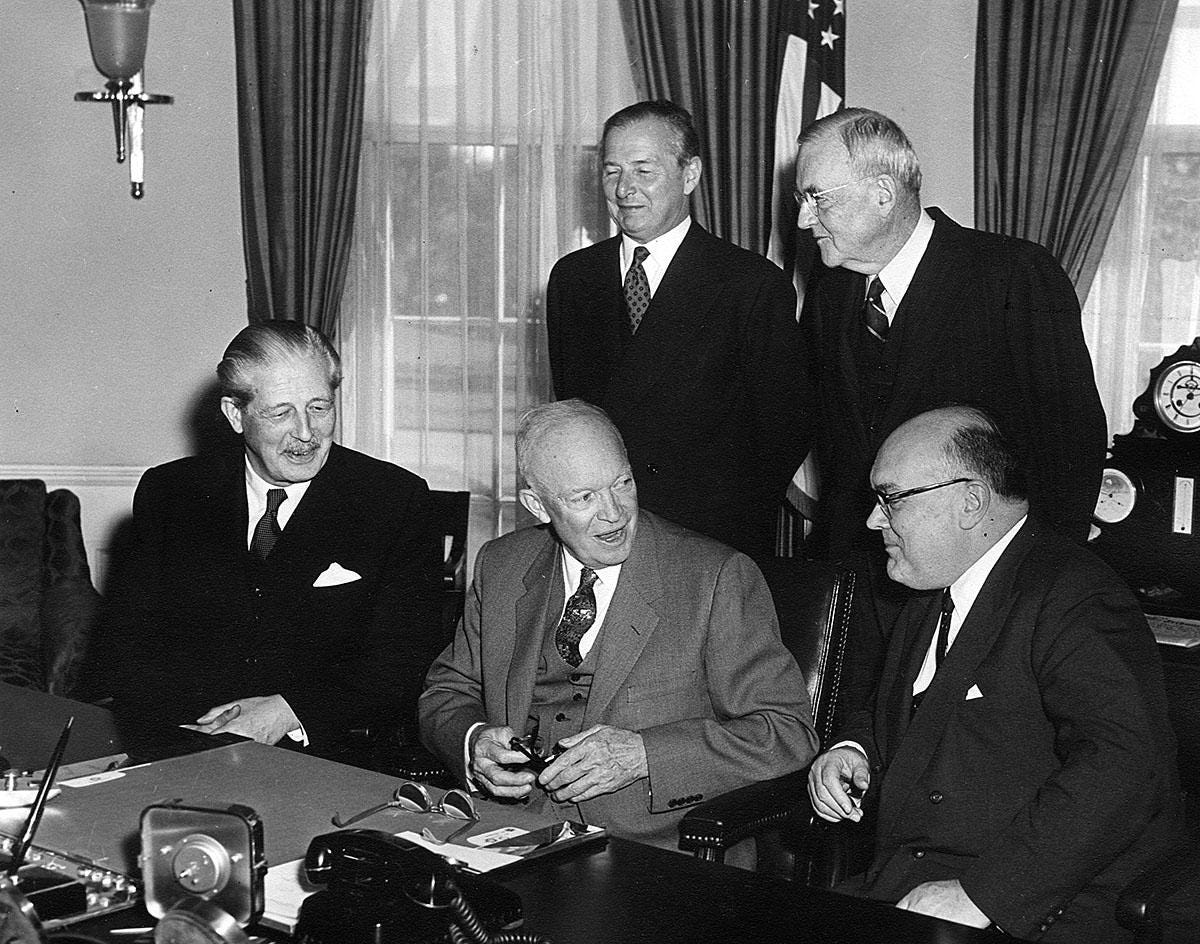
The second pillar fell with the first. NATO’s credibility as a security guarantee has always depended less on the text of Article 5 than on the shared conviction that it would be honoured instantly and without negotiation. Once that conviction wavers, adversaries recalculate. Deterrence does not fail when an alliance formally dissolves. It fails when an opponent concludes that the response will be slow, divided, or incomplete. That calculation has already changed.
The third pillar, the stability of long-term planning, has been shattered by the sheer velocity of strategic change. Defence procurement operates on cycles of decades. Aircraft carriers commissioned today were designed fifteen years ago. The nuclear deterrent requires planning horizons stretching into the 2060s. All of this assumes a stable framework within which to make choices. When the most important variable in British defence, the reliability of the American alliance, becomes unpredictable from one administration to the next, every long-term assumption is called into question. What platforms to buy, which capabilities to prioritise, how to structure forces: none of these decisions can be made rationally when the foundation keeps moving.
The fourth pillar was political. For decades, both major parties treated defence as important enough to fund at modest levels but not important enough to displace domestic priorities. That consensus depended on the other three pillars holding. If America would always come, if NATO would always deter, if planning could proceed in an orderly fashion, then defence could safely be managed rather than prioritised. Once the other three pillars cracked, the fourth became untenable.
The scale of that disruption is historically unusual. The strategic challenge Britain now faces is arguably more severe than that confronted by the Attlee government after 1945. Then, Britain was exhausted, indebted and losing an empire, but it had clarity about the threat and certainty about its principal ally. Today, Britain is wealthier, technologically advanced and militarily capable, but strategically adrift. The threat is diffuse. The ally is distracted. And the country has not yet accepted what follows from either.
How did we get here?
These pillars did not crack under external pressure alone. They were hollowed out from within by choices made over decades.
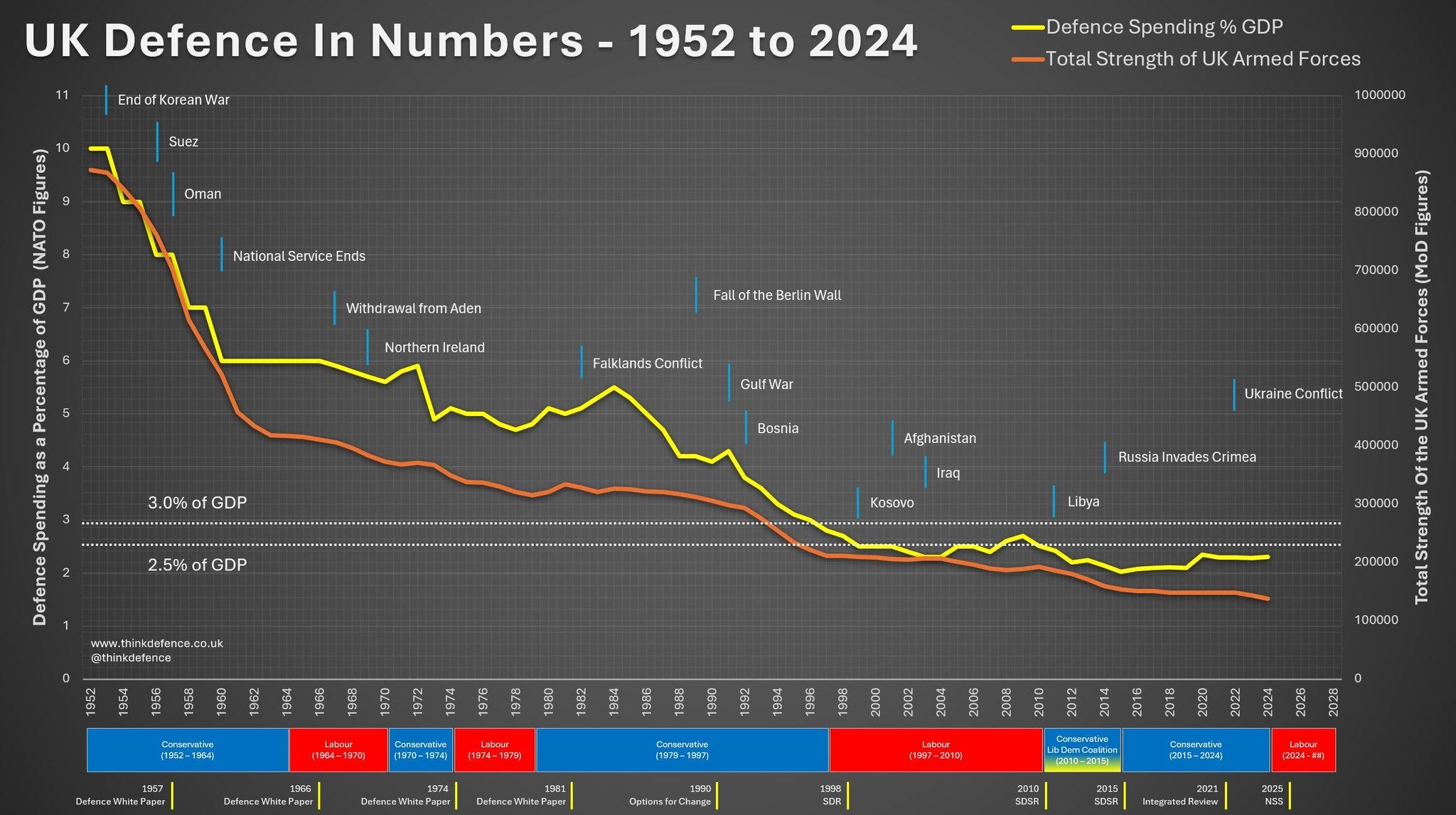
The dependence on American support was not imposed. It was chosen, repeatedly, because it was cheaper and easier than the alternative. Each successive defence review since the Cold War trimmed capabilities that only made sense if someone else provided the enabling architecture. Britain retained world-class platforms, including submarines, fast jets and special forces, but shed the connective tissue that would allow them to operate independently: strategic airlift, satellite communications, air-to-air refuelling at scale, deep ammunition reserves. The result was a force designed to plug into an American-led system, not to stand on its own.
The reliance on NATO followed the same logic. If the alliance guaranteed security, there was no need for European states to build the redundancy that independent action would require. Interoperability became a euphemism for dependency. Command structures, logistics chains, and intelligence-sharing protocols were all optimised on the assumption that the United States would always be the lead framework nation. When that assumption holds, the system is formidable. When it does not, the system has no fallback.
The stability of long-term planning was undermined by something more insidious: the belief that the strategic environment would remain broadly predictable. Defence reviews were conducted on five- to ten-year cycles, each one adjusting to incremental shifts. The possibility of sudden, systemic disruption, whether an ally reversing course, a major war in Europe, or the simultaneous emergence of multiple peer threats, was acknowledged in risk registers but never seriously planned for. The system was built to manage change, not to survive shock.
The political consensus held longest because it was the most convenient. Defence spending could be kept low without visible consequence so long as the other three pillars remained intact. No government paid a political price for underfunding defence. No opposition made it a central issue. The public, understandably, had no reason to question an arrangement that appeared to work. By the time the foundations had eroded, the political habit of deferral was so deeply ingrained that even a land war in Europe did not fundamentally alter the terms of debate.
At the World Economic Forum in Davos in January 2026, German Chancellor Friedrich Merz announced that Germany would raise defence spending towards 5 per cent of GDP and argued that Europe must become capable of defending itself independently.1 That a German chancellor felt compelled to say this publicly tells you how far the old order has already shifted.
The NATO commitment agreed at The Hague in June 2025 formalised the scale of what is now required. Allies committed to spending 5 per cent of GDP on defence and security by 2035, split between 3.5 per cent on core defence and 1.5 per cent on broader security and resilience.2 For Britain, that means roughly doubling current defence-related spending within a decade. This is not an aspiration. It is an admission that the existing level of investment cannot sustain credible deterrence.
What can be done
If the pillars have fallen, what replaces them? Neither nostalgia nor incrementalism. The task is to build a new framework on different assumptions.
The first assumption must be that American support, while desirable, cannot be guaranteed. This does not mean hostility towards Washington. It means prudence. Britain must identify which US-provided capabilities are most critical to its own force and begin building alternatives or redundancy into them: sovereign or allied satellite communications, European strategic airlift, integrated air and missile defence that does not depend on a single provider, and command-and-control systems that function when the principal ally is engaged elsewhere.
Consider just one of those capabilities. SpaceX invested at least $10 billion to build the Starlink constellation, now more than 9,000 satellites providing communications that have proved essential in Ukraine.3 No European country can replicate that alone. But could Britain share it with France? Or Germany? Or Australia and Japan? A shared satellite communications programme, built on existing British and French space expertise, reaching around the world would cost a fraction of what each nation would spend duplicating it independently. The same logic applies across the enabler gap. The question is not whether these things are affordable. It is whether we can afford not to build them together.
The second assumption must be that NATO endures but changes character. The alliance will remain the essential framework for European security, but it will operate increasingly as a coalition in which Europeans bear the principal burden for their own defence. Britain, as one of only two European nuclear powers, with one of the continent’s largest defence budgets and most deployable forces, cannot avoid a leadership role in that transition. The question is not whether Britain leads, but whether it leads deliberately or is dragged into responsibility unprepared.
The third assumption must be that planning cannot depend on stability. Defence procurement and force design must become more adaptive. Shorter development cycles, modular platforms, and the ability to scale production rapidly matter more than exquisite systems optimised for a single scenario. The countries that have adapted fastest to the realities of modern conflict, building new industries from scratch, converting civilian logistics into military supply chains, iterating weapons systems in weeks rather than years, are the ones setting the pace. Britain must learn from them.
The fourth assumption must be that political consensus on defence will not form by itself. It must be built. Air Chief Marshal Sir Rich Knighton, the Chief of the Defence Staff, has said that the current threat environment is more dangerous than at any point in his career and that responding to it requires a whole-of-nation response: building industrial capacity, growing the skills we need, and increasing the resilience of society and the infrastructure that supports it.4 That language is not routine. It is a serving military chief telling the country that defence is no longer a problem the armed forces can solve alone.
Building that consensus requires honesty. The British public has not been told clearly what the country faces, what it will cost, or what the consequences of inaction would be. Governments of both parties have preferred reassurance to candour. That must change and that’s why I’ve been writing these articles. The public are not children. They can weigh difficult choices if they are trusted with the facts.
Four pillars of British defence were dismantled in fifty days. They will not be rebuilt on the same foundations. The assumptions that sustained them, American constancy, allied automaticity, strategic predictability, political convenience, belong to a world that no longer exists. The only real question is whether Britain builds something new before events force our hand.
World Economic Forum, Special address by Friedrich Merz, Federal Chancellor of Germany, Davos, January 2026. https://www.weforum.org/stories/2026/01/special-address-by-friedrich-merz-federal-chancellor-of-germany/.
NATO, The Hague Summit Declaration, June 2025. https://www.nato.int/cps/en/natohq/official_texts_236705.htm.
SpaceX estimated the total cost of designing, building and deploying the Starlink constellation at US$10 billion (May 2018), later revised to $20 to $30 billion. See CNBC, What’s behind SpaceX’s $74 billion valuation, February 2021. https://www.cnbc.com/2021/02/19/spacex-valuation-driven-by-elon-musks-starship-and-starlink-projects.html.
Chief of the Defence Staff speech, 15 December 2025. https://www.gov.uk/government/speeches/chief-of-the-defence-staff-speech-15-december-2025.

So much work to do. Sir Richard Knighton, Sir Gyn Jenkins, Blaise Metreweli, and others have clearly communicated the scope of the challenge. The professionals are shouting for help, but the political class has not yet heard. Desperately hoping that the delay to DIP is because the exchequer has realized it needs to find billions. Of course, the lack of communication will make it a harder sell.
Thanks for a brilliant writing! 😊👍