

Where we are now
For almost 80 years, Britain’s ultimate guarantee of security has depended not just on our own Continuous At Sea Deterrence, but on another, largely unspoken assumption: that we have the United States in our corner.
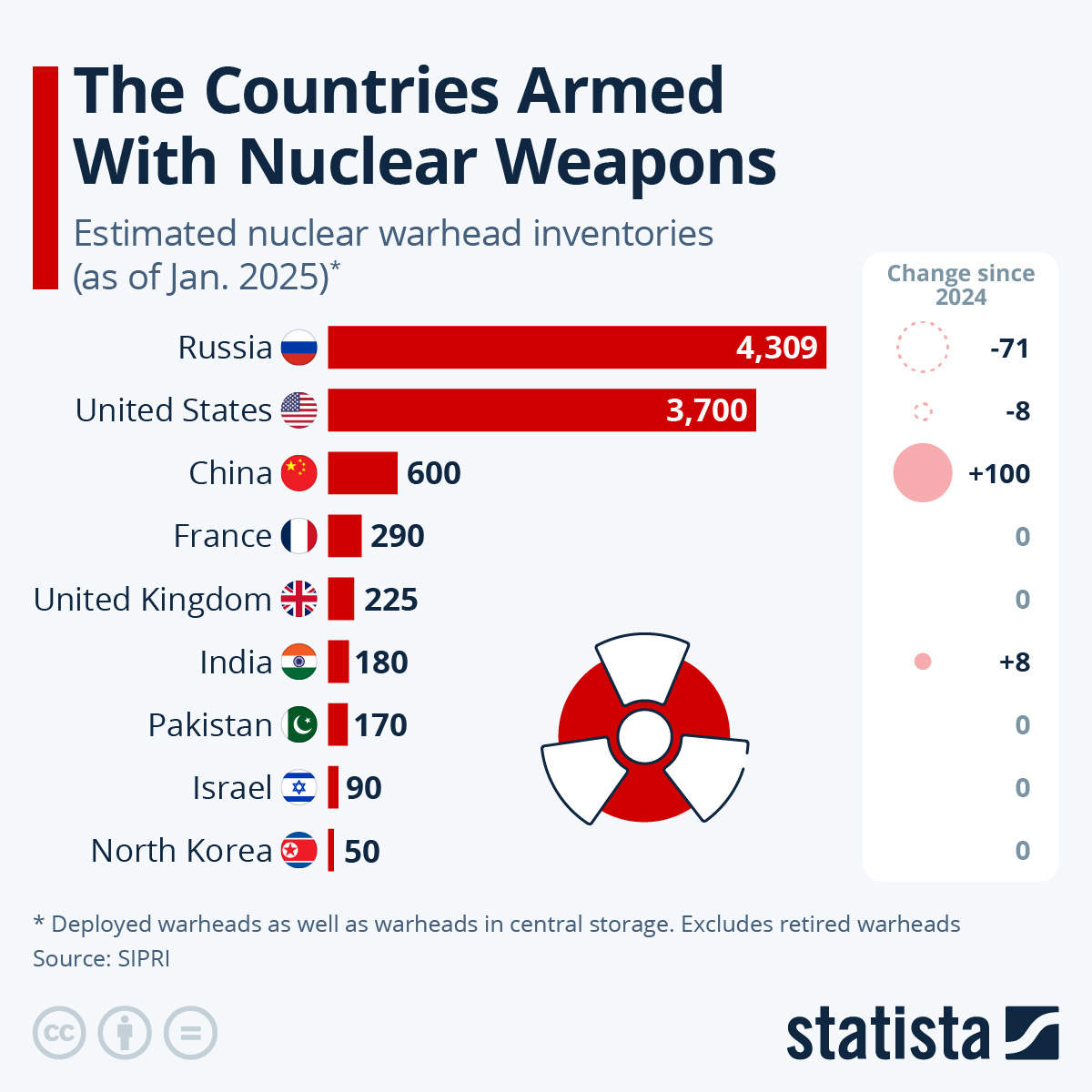
America’s nuclear umbrella, at sea, through strategic forces based in the United States, and through NATO’s wider nuclear arrangements in Europe, has underpinned European security since 1945. The United States maintains roughly 3,700 nuclear warheads, of which around 1,700 are deployed.1 Attack Britain, or any NATO state, and you risk American retaliation. That logic carried Europe through the Berlin Airlift, the Cuban Missile Crisis, and the long-frozen decades of the Cold War. It allowed European states to disarm, demobilise, and redirect national wealth away from warfare and towards welfare.
Closer to home, the United States is not simply a political guarantor of Britain’s deterrent; it is part of the delivery system. Britain’s deterrent is operationally independent, only the Prime Minister can authorise its use, but Trident missiles are leased from a shared pool in the United States. Maintenance and key aspects of support depend on US facilities and industry.2
This arrangement has functioned because political alignment between the US and UK was assumed to be permanent. If that alignment becomes conditional, the question becomes unavoidable: how resilient is Britain’s deterrent if American support becomes uncertain at precisely the moment it matters most?
Today, that assumption is creaking.
Confidence has been eroded by President Donald Trump repeatedly stating that allies who do not meet defence spending commitments should not expect automatic American protection.3 His administration has openly discussed reducing US troop levels in Europe, which have been around the 100,000 mark in recent years.4 Senior figures around him have questioned whether extended deterrence in Europe remains central to American interests when the primary strategic focus has shifted towards China. None of this constitutes withdrawal. But deterrence is about belief, not legal text, and belief has turned to doubt.
For Britain, this creates an uncomfortable reality. Our ultimate security guarantee, the one that has underwritten every defence choice since the Second World War, can no longer be assumed. It must be recalculated every day.
How did we get here
Britain’s nuclear journey began in the early 1940s, when the existential threat posed by Nazi Germany drove unprecedented scientific collaboration. Through Tube Alloys, Britain pooled nuclear research with the United States, feeding directly into the wartime effort that became the Manhattan Project.5 The partnership never fully ended. Britain built an independent warhead, but over time it embedded itself in an unusually close nuclear relationship with Washington, formalised through post war agreements on cooperation and sustained through shared systems, shared facilities, and shared supply chains.6
The Suez Crisis in 1956 hardened that dependence into doctrine. Britain and France acted militarily without American backing and found themselves brought up short by US financial pressure, which accelerated a withdrawal that London experienced as humiliation.7 The lesson Britain drew was that strategic independence without American support was not a plan, it was a gamble. Britain embedded itself more tightly within a US led system. France drew the opposite conclusion. Under de Gaulle, it accelerated a sovereign force de frappe designed to ensure that French national survival could never again be subject to allied veto.8
From different paths, Britain and France emerged as Europe’s only nuclear armed states.
Britain is assessed as holding approximately 225 nuclear warheads.9 France is assessed at around 290.10 Combined, that gives Europe’s two nuclear powers roughly 515 warheads.11 Russia, by contrast, is assessed at roughly 5,500 total nuclear warheads, with around 1,700 deployed and a large non-strategic stockpile often estimated in the low thousands.12
On paper, the disparity is overwhelming.
Yet nuclear deterrence has never been about matching numbers. It is about the ability to impose unacceptable damage. In that sense, 515 warheads are more than enough. A small fraction of Britain’s and France’s arsenals could devastate Russia’s political leadership, military command, and critical national infrastructure. No rational leadership would choose that outcome.
But deterrence is not a mathematical equation. It is a psychological contest shaped by escalation ladders, perceived options, and credibility.
Russia’s advantage is not merely numerical. It is doctrinal. Moscow retains a substantial stockpile of lower yield, non-strategic nuclear weapons, designed to threaten limited use in order to coerce an opponent and shape escalation.13 Britain and France, by contrast, have overwhelmingly strategic postures. That asymmetry creates a dangerous grey zone in which Russia can threaten limited nuclear use while betting that Europe would hesitate to respond in kind.
The hardest challenge is not capability but credibility.
Would Britain launch nuclear weapons to defend Estonia? We say yes. Would Moscow believe it? More pointedly, would Moscow believe Britain would act even if the United States opposed or withheld support?
This is the dilemma identified by European strategists and institutions such as Bruegel and others analysing post American extended deterrence.14 Smaller nuclear states face a sharper escalation problem. Britain is a densely populated island. France is compact and highly centralised. A nuclear exchange would be existential for both. Russia, by contrast, has greater geographic depth and a broader, more graduated toolkit. That reality shapes adversary calculations. Moscow may gamble on hesitation, delay, or political fracture.
Deterrence fails not when intentions change, but when belief does.
This is why confidence in the American guarantee has mattered so much. The United States can absorb damage and continue to fight. Its credibility rests not only on resolve, but on scale. Europe does not have that luxury.
In July 2025, during a state visit by President Macron, Britain and France signed what became known as the Northwood Declaration. It passed with little public debate. Strategically, it was momentous. For the first time, Britain and France committed to coordinate their nuclear forces in response to threats affecting their vital interests, with language intended to signal that there is no extreme threat to Europe that would not engage them both.15
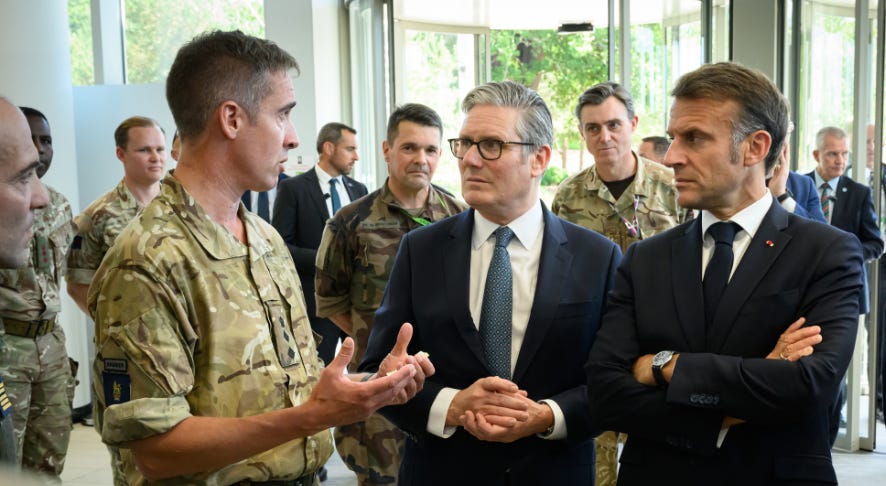
This was not a merger of deterrents. But it was a clear signal that Europe’s nuclear powers were preparing for a world in which American guarantees could no longer be assumed to be unconditional. Northwood marked a shift from parallel postures to shared intent.
Similar conversations are taking place, more quietly, in Europe’s capitals, including public debate in Germany about whether Franco British capabilities could play a larger role in European deterrence.16 This is not an attempt to replace NATO. It is an attempt to insure against the weakening of the assumption that has underpinned it.
What can be done
Amongst these changes, there are no silver bullets but there are choices.
First, Britain must ensure its deterrent is unquestionably reliable. Missile test failures, submarine availability gaps, and skills shortages erode confidence.² That means sustained investment in the deterrent, and clear delivery against commitments already made, including the UK’s warhead programme and submarine renewal. A deterrent doubted by its owner is already failing.
Second, deeper coordination with France now looks necessary for both political and operational credibility. That does not mean proliferation. It means shared planning assumptions, coordinated exercising, and clear consultation mechanisms so that adversaries face fewer ambiguities about how Britain and France would respond under pressure. Northwood is a start. It is not yet a system.¹⁵
Third, Britain must be honest about the limits of nuclear weapons. They deter nuclear attack. They do not deter cyber operations, sabotage, election interference, or economic coercion. Russia and China operate below the threshold precisely because they know nuclear weapons are irrelevant there. Deterrence in the grey zone requires resilience, redundancy, and conventional strength, not slogans.
Finally, Britain must resist the temptation to treat nuclear weapons as a substitute for conventional capability. They are not. They are an insurance policy against catastrophe, not a tool for everyday defence. If the only credible response to aggression is nuclear annihilation, then deterrence becomes less credible, not more.
What ultimately matters is whether potential adversaries believe that Europe’s nuclear powers know exactly what they are prepared to do, and exactly what they are not. Deterrence rests on clarity, credibility, and confidence. Ambiguity, once a strength, is becoming a liability.
We are approaching a moment when assumptions forged in the twentieth century will be tested in the twenty first. The question is whether Britain adapts before that test arrives, or learns the hard way that deterrence only works when it is believed.
Bulletin of the Atomic Scientists, United States Nuclear Weapons 2025, January 2025: https://thebulletin.org/premium/2025-01/united-states-nuclear-weapons-2025/.
Financial Times, UK has ‘absolute confidence’ in nuclear deterrent after test failure, February 2024: https://www.ft.com/content/022ff38e-e118-4643-b516-3b2e5ff6ffc3.
NPR, Trump says he wouldn’t defend NATO allies from Russia if they’re ‘delinquent’, February 2024: https://www.npr.org/2024/02/11/1230658309/trump-would-encourage-russia-to-attack-nato-allies-who-dont-pay-bills.
Statista, Number of active-duty United States military personnel in Europe in 2025, by country, November 2025: https://www.statista.com/statistics/1294271/us-troops-europe-country/?srsltid=AfmBOoq1MmLw7sQpNgUn7zeJIqRlrEXbfYRkpDuSSyYvL9cGq1GCvYMc.
The Chemical Engineer, History of Nuclear Engineering Part 2: Building the Bomb, March 2024: https://www.thechemicalengineer.com/features/history-of-nuclear-engineering-part-2-building-the-bomb/.
UK Government, Agreement between the United Kingdom and the United States of America for Co-operation on the Uses of Atomic Energy for Mutual Defence Purposes, July 1958: https://treaties.fcdo.gov.uk/data/Library2/pdf/1958-TS0041.pdf.
US Department of State, Office of the Historian, The Suez Crisis, 1956: https://history.state.gov/milestones/1953-1960/suez.
Fondation Robert Schuman, French nuclear deterrence and Europe, November 2025. https://www.robert-schuman.eu/en/european-issues/811-french-nuclear-deterrence-and-europe.
Bulletin of the Atomic Scientists, United States Nuclear Weapons 2025, January 2025: https://thebulletin.org/premium/2025-01/united-states-nuclear-weapons-2025/.
Bulletin of the Atomic Scientists, United States Nuclear Weapons 2025, January 2025: https://thebulletin.org/premium/2025-01/united-states-nuclear-weapons-2025/.
SIPRI, World nuclear forces, June 2025: https://www.sipri.org/media/press-release/2025/nuclear-risks-grow-new-arms-race-looms-new-sipri-yearbook-out-now.
Federation of American Scientists, Nuclear Notebook, Russian Nuclear Weapons, 2025, May 2025: https://fas.org/publication/nuclear-notebook-russia-2025/.
RAND, Understanding Russian strategic culture and the low-yield nuclear threat, August 2025: https://www.rand.org/pubs/research_reports/RRA3859-1.html.
Bruegel, How can Europe’s nuclear deterrence trilemma be resolved?, June 2025. https://www.bruegel.org/working-paper/how-can-europes-nuclear-deterrence-trilemma-be-resolved.
UK Government, UK and France agree new nuclear cooperation framework, July 2025: https://www.gov.uk/government/news/northwood-declaration-10-july-2025-uk-france-joint-nuclear-statement.
CSIS, Can France and the United Kingdom Replace the U.S. Nuclear Umbrella?, March 2025: https://www.csis.org/analysis/can-france-and-united-kingdom-replace-us-nuclear-umbrella.

👍
https://thebluearmchair.substack.com/p/ww3-humour?r=5kmhkr