

Where we are now
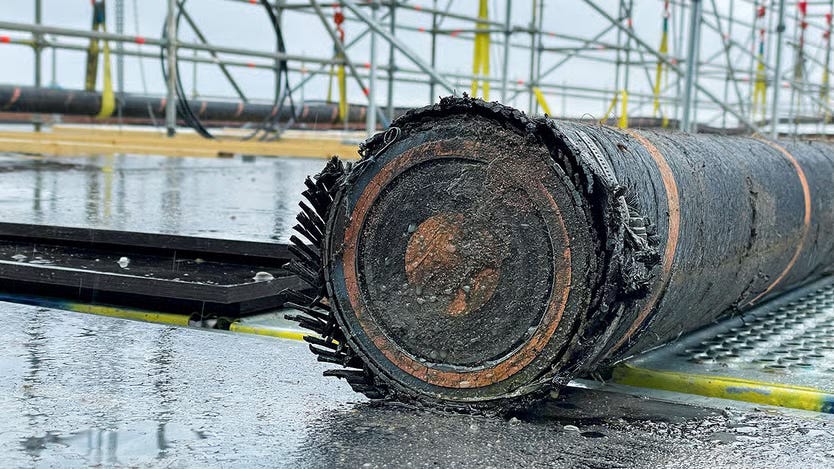
On Christmas Day 2024, while most of Britain was absorbed by family rituals and repeats on television, a Russian linked tanker dragged its anchor across the seabed between Finland and Estonia. It tore through a major cross-border electricity interconnector and four communications cables. Power was disrupted and data traffic was severed. Within weeks, investigators had established that this was no accident. Sabotage, not poor seamanship, had been carried out in a region already experiencing a surge in similar incidents.
In November and December 2025 alone, seven undersea cables were cut in the Baltic Sea.1 The pattern was unmistakable. Commercial vessels with opaque ownership structures lingered over sensitive infrastructure, slowed unexpectedly, or altered course in ways that defied normal maritime practice. European navies and coast guards began to respond, but only after the damage had already been done.
This activity offshore mirrors a broader escalation on land and online. Russian hostile actions across Europe almost tripled between 2023 and 2024.2 In the United Kingdom, the National Cyber Security Centre handled 430 cyber security incidents in the most recent reporting year, up from 371 the year before.3 More striking still was the sharp rise in attacks classified as nationally significant, meaning incidents capable of disrupting essential services, the economy, or the functioning of government.
These numbers do not capture the human consequences. In June 2024, a Russian linked criminal group carried out a ransomware attack on major London hospitals. Operations were cancelled, blood transfusions were delayed, and diagnostic services were suspended. Large volumes of sensitive patient data were stolen and later released online.4 This was not espionage in the shadows but sabotage carried out in full view.
Senior figures in Britain’s security establishment have been unusually blunt about what this means. General Sir Gwyn Jenkins, the First Sea Lord and Chief of the Naval Staff, has warned publicly that Russia’s deep-sea sabotage capability now includes specialised assets designed to interfere with seabed infrastructure. Russian intelligence vessels have been repeatedly observed loitering above cables linking the United Kingdom and Ireland. As he has noted, the difficulty lies in distinguishing provocation from preparation until it is too late and damage has already occurred.5
The intelligence services are equally clear. The Chief of MI6, Blaise Metreweli, has accused Moscow of deliberately testing Britain through what are known as grey zone activities, including cyber-attacks, sabotage, and the harassment of airports and military sites using drones. The Defence Secretary has described the current threat environment as less predictable and more dangerous than at any point since the Cold War.
This threat is not confined to the maritime or digital space. British police have arrested individuals suspected of acting on behalf of Russian military intelligence in connection with plots involving incendiary devices at logistics facilities. German authorities have warned that similar devices, had they detonated aboard aircraft, could have caused catastrophic loss of life.6 These incidents were not occurring in Ukraine or on NATO’s eastern flank. They were unfolding in the heart of Europe.
Still, for most people, they barely register.

How did we get here?
Should we be surprised? We live busy lives, and surely defence and security professionals are trained and resourced to anticipate and mitigate these risks?
The problem is that a dangerous gap has opened between elite understanding and public perception, and it has widened steadily over recent decades.
When the Cold War ended, Britain and its allies made a series of assumptions that felt reasonable at the time. Defence spending fell sharply across Europe. In the UK, it declined from over 4 percent of GDP in the late 1980s to around 2 percent by the early 2000s.7 Industrial capacity was allowed to atrophy. Stockpiles were run down. Intelligence agencies and armed forces were reoriented towards counter-terrorism and expeditionary operations in distant theatres.
This was hailed as the Peace Dividend. Russia was expected to integrate into the international system. China was expected to liberalise as it prospered. Globalisation was assumed to be both economically efficient and strategically stabilising.
That worldview shaped our infrastructure. Energy systems were designed for efficiency rather than resilience. Telecommunications networks prioritised speed and cost over redundancy. Undersea cables, which now carry more than 95 percent of intercontinental data traffic and underpin trillions of pounds in daily financial transactions,8 were treated as commercial assets rather than strategic ones.
The same logic applied to cyberspace. Digital systems were adopted at pace, often without serious consideration of how they might be exploited by hostile states. Responsibility for defence was fragmented across departments and agencies. Warning signs were noted, but rarely translated into sustained investment, because the threat felt abstract and distant.
Russia, by contrast, drew very different lessons from the end of the Cold War. It studied Western dependence on complex, interconnected systems and concluded that direct military confrontation was neither necessary nor desirable. Instead, it developed a doctrine of continuous competition below the threshold of war. Cyber operations, sabotage, disinformation, and deniable proxies became tools for shaping the strategic environment without triggering a unified response.
After the cyber-attack on Estonia in 2007 and the invasion of Georgia in 2008, the annexation of Crimea in 2014 should have shattered any remaining illusions. Instead, much of Europe treated it as an aberration. Defence spending ticked up slowly and unevenly. Procurement systems remained ponderous. Industrial output stayed optimised for peacetime efficiency rather than wartime scale.
The result is an uncomfortable paradox. Britain remains one of the world’s leading military powers, with highly capable forces and world-class intelligence services, but it is increasingly vulnerable at home. The foundations of national life were never designed to withstand sustained hostile pressure, nor to compensate for deep dependencies on hostile powers, particularly China, for critical components and supply chains.
When senior military leaders warn privately about this, they often encounter the same response. Russia is not really going to invade, is it? China will not really stop selling us the components we need, will it?
The answer is that they do not need to. Many of the objectives they seek can be achieved by disruption alone. Undermining confidence, raising costs, and forcing democratic governments into constant crisis management does not require war. It requires confusion and worry.
That is the reality of modern conflict. It is not announced. It is experienced.
What can be done
Responding to this challenge requires urgency, realism, and honesty. There are no silver bullets, but there are clear priorities.
The first is to harden nationally vital assets. Undersea data cables, power interconnectors, ports, and data centres must be treated as critical national infrastructure. That requires persistent monitoring, better intelligence sharing with allies, and clear lines of responsibility for protection and response. The North Sea and the approaches to the British Isles are among the most densely wired regions on earth. They should also be among the most closely watched.
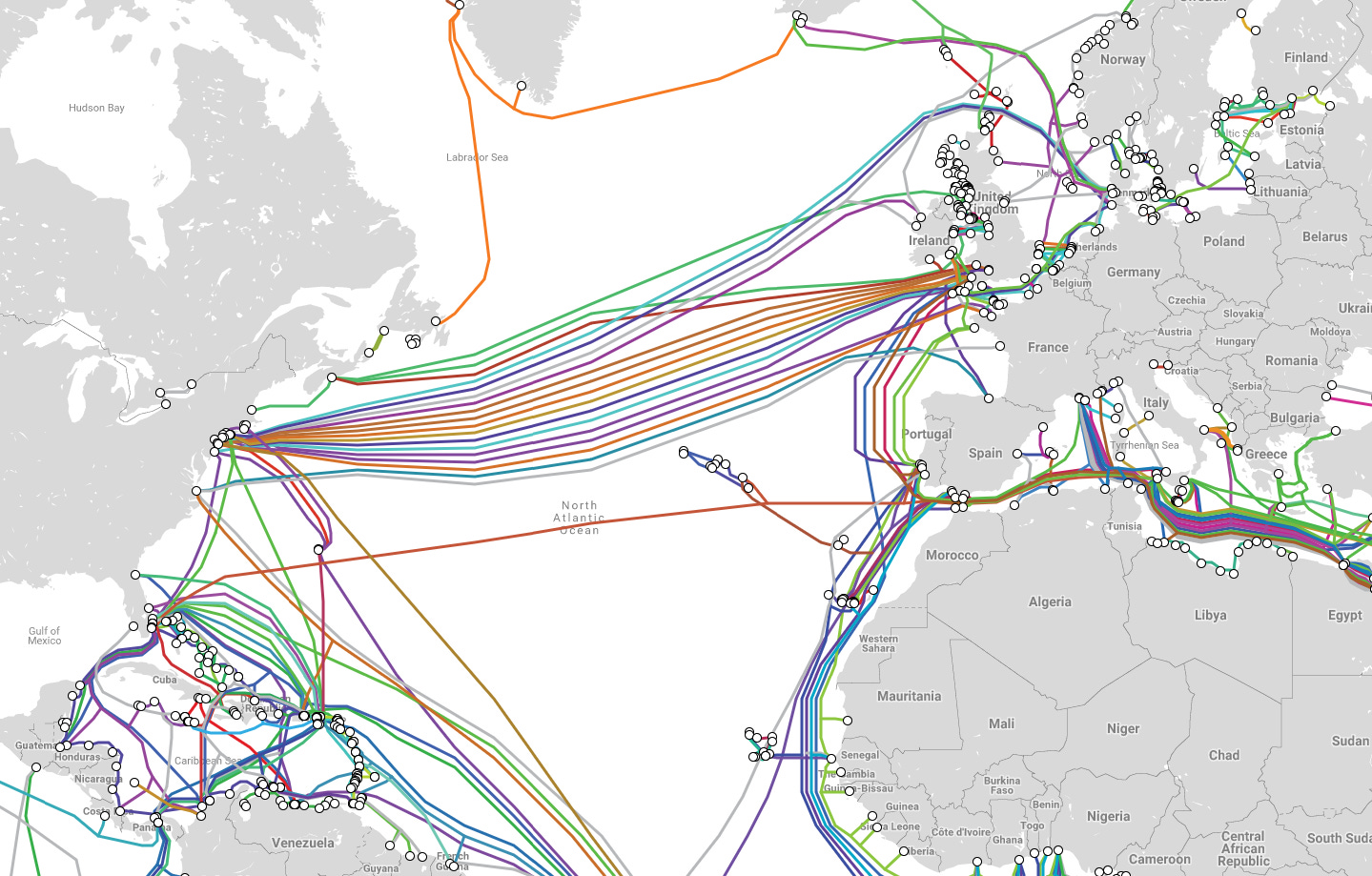
The government has committed funding to homeland defence, but the scale of the task is far larger than headline figures suggest. Protecting a single major interconnector or offshore energy installation can cost tens of millions of pounds once surveillance, redundancy, and rapid repair capability are factored in. Prioritisation is essential, and so is speed. At present there is no single department or minister responsible. Energy, Transport, Defence, the Home Office, and the Environment all have a stake. That has left a chorus of voices with no conductor.
There are encouraging examples to build on. Northern European states are increasingly pooling maritime surveillance and patrols. Industrial cooperation is expanding, including joint shipbuilding programmes that allow multiple yards across allied countries to produce and maintain the same classes of vessels. This increases resilience, reduces costs, and ensures that no single nation becomes a bottleneck.
The second priority is cyber defence. Britain needs a genuinely unified cyber command, capable of coordinating defensive operations across government, critical national infrastructure, and where necessary the private sector. The planned Cyber and Electromagnetic Command is a step in the right direction, but it must be empowered from the outset with clear authority and adequate resources.
The lesson from Ukraine is that cyber conflict is fast, adaptive, and relentless. Fragmentation is a liability. Speed matters as much as sophistication. Defensive resilience across health, transport, energy, and finance is as vital as offensive capability.
The third and most difficult task is public understanding. Defence spending does not compete with public services. It underpins them. Hospitals cannot function without power and data. Banks and businesses cannot operate without the cables that keep networks connected. Everyday life depends on infrastructure that is now threatened.
That reality needs to be explained honestly. Not to alarm, but to inform. Democratic societies cannot sustain the level of investment and institutional reform required for defence without public consent. That consent rests on trust, and trust depends on transparency.
Russia, China, and even nations we are not confronting directly understand this dynamic well. Their actions are designed not just to disrupt systems, but to test political will. Every unanswered provocation is a data point. Every delayed response is an encouragement.
Britain still has choices. We have allies and capabilities. What we cannot afford is complacency. This hidden war is already under way. The question is whether we acknowledge it in time to shape its outcome, or continue to notice it only when the lights go out.
Endnotes
Financial Times, Inside Russia’s shadow war in the Baltics. https://ig.ft.com/baltic-sea/.
Center for Strategic and International Studies, Russia’s Shadow War Against the West, 2025. https://www.csis.org/analysis/russias-shadow-war-against-west; Meduza, There Has to Be a Cost, 21 March 2025. https://meduza.io/en/feature/2025/03/21/there-has-to-be-a-cost.
UK National Cyber Security Centre, Annual Review 2024. https://www.ncsc.gov.uk/collection/ncsc-annual-review-2024; Infosecurity Magazine, UK cyber attacks surge as NCSC reports 430 incidents. https://www.infosecurity-magazine.com/news/uk-cyberattacks-surge-ncsc/.
BBC News, NHS pathology provider confirms patient data stolen in cyber attack, June 2024. https://www.bbc.co.uk/news/articles/c9777v4m8zdo; Financial Times, NHS cyber attack led to patient death, June 2025. https://www.ft.com/content/773c031b-a4e9-4120-bea6-d3d4c3eecdc4.
Financial Times, UK cannot ignore deep-sea threat from Russia, head of Navy warns, December 2025. https://www.ft.com/content/3518c4c2-4589-4d25-b4bd-6f5608c0720a.
Reuters, German firms warned of packages containing incendiary devices, August 2024. https://www.reuters.com/world/europe/german-security-services-warn-danger-packages-containing-incendiary-devices-2024-08-30/#:~:text=In%20the%20letter%20dated%20Wednesday,to%20logistics%20and%20freight%20companies.
Stockholm International Peace Research Institute, Military Expenditure Database. https://milex.sipri.org/sipri; UK Ministry of Defence, UK Defence in Numbers. https://www.gov.uk/government/collections/uk-defence-in-numbers.
International Telecommunication Union, Submarine cable resilence. https://www.itu.int/en/mediacentre/backgrounders/Pages/submarine-cable-resilience.aspx.


Great article. In my view it reinforces the argument that Britain is an Atlantic power first. We are anchored in our geography and our strategic position in the GIUK gap allows us to monitor access and if necessary prevent access in the arctic region. Totally agree with the point that defence underpins all other public spending. We need to start thinking about it in that way, as something never to compromise on.
EXCELLENT cautionary analysis.
How many bloody warnings will it take, how long to toughen up our intelkectually soft, spoiled societies before the hard men of the world plough us under!