

Where we are now
In the summer of 2023, artillery accounted for 90 percent of battlefield casualties in Ukraine. Eighteen months later, drones account for somewhere between 70 and 80 percent.1 That is not a gradual evolution in how wars are fought. It is a rupture.
The shift has happened in real time, under constant observation, and at a pace that should unsettle anyone responsible for Britain’s defence. What we’re watching in Ukraine isn’t a niche capability maturing on the margins. It’s the centre of gravity of modern warfare moving decisively away from traditional platforms and towards mass autonomy, and attrition.
The New Yorker’s Dexter Filkins was recently taken inside a secret Ukrainian drone factory. What he found was not a cavernous weapons plant, but something closer to a university lab. Women in their twenties tended rows of 3D printers. Music played in the background. The factory produces around a thousand drones a day, each costing roughly five hundred dollars. In one video shown to Filkins, a drone plunges into a Russian TOS-1 heavy flamethrower system, a platform worth several million dollars, and destroys it completely. As the factory manager put it, one of their drones costs a tiny fraction of what it destroys.2 That is the advantage.
In 2024, Ukraine produced approximately two million drones. Around 96 percent of all drones used by its armed forces were domestically made.3 By the end of 2025, production had reached 4.5 million, more than doubling in a single year.4 These are not exquisite systems designed to survive. They are cheap, disposable, and built to be lost. Ukrainian commanders have learned that a thousand adequate drones matter more than ten perfect ones.
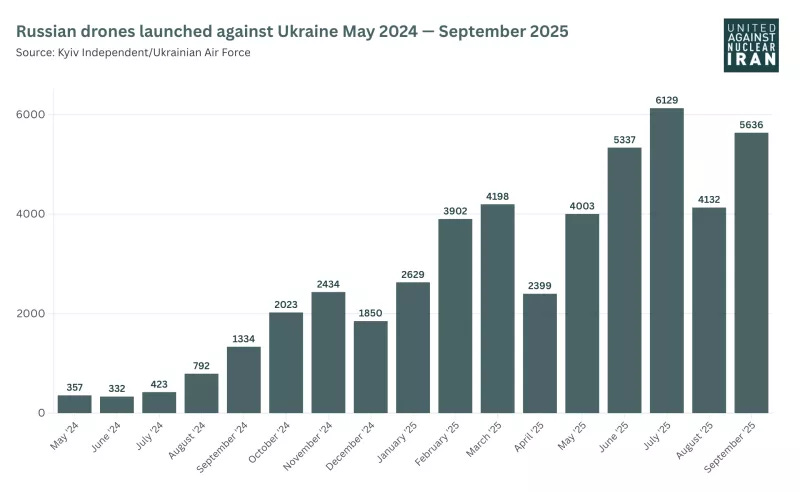
The human cost of this shift is staggering. Russia has now suffered close to a million casualties in its invasion of Ukraine. According to Ukrainian President Volodymyr Zelenskyy, roughly 80 percent of those losses have been inflicted by drones.5 This is not just about frontline skirmishes.
Drones now also account for more civilian casualties than any other weapon. A United Nations Human Rights Commission report recently concluded that, along a 185-mile stretch of the Dnipro River, Russian drones are part of “systematically coordinated actions designed to drive Ukrainians out of their homes,” a crime against humanity. One local resident told investigators, “We are hit every day. Drones fly at any time, morning, evening, day or night, constantly.”6
In June 2025, Ukraine launched the most audacious long-range drone attack in modern history. More than a hundred drones struck targets deep inside Russia, as far away as Siberia, only a few hundred miles from the Chinese border, damaging or destroying around twenty military aircraft. The drones were smuggled into Russia in pieces, assembled, and loaded onto trucks by a fake logistics company without the drivers’ knowledge. They flew from locations up to 2,500 miles inside Russian territory.
This was a stunning example of the new tech capability, shrinking Russia’s vaunted strategic depth without sending an army across the border. Austria’s foreign minister, Alexander Schallenberg, called it “the Oppenheimer moment of our generation”.7 The analogy is not hyperbole. Just as nuclear weapons rewrote the logic of great power conflict, cheap autonomous systems are rewriting the logic of conventional war. Britain is watching this revolution from the sidelines.
How did we get here?
Ukraine is not simply using drones. It is reorganising the battlefield around them.
Along the front line, Ukrainian forces are creating a 15-kilometre-deep unmanned kill zone, with plans to extend it to 40 kilometres. Within that space, movement is detected, classified, and targeted automatically as partnership with companies like Palantir is transforming the understanding of the battlespace. More than 70 types of unmanned ground vehicles have been tested, performing tasks from reconnaissance to logistics and evacuating wounded soldiers under fire.8
At sea, the transformation has been even more dramatic. Ukraine entered the war with a negligible navy. It now possesses one of the most innovative maritime strike capabilities in the world. Magura naval drones, small low-profile vessels made of fibreglass and polyethylene, have repeatedly struck Russian warships. In early 2024, Magura wolf packs, inspired by World War 2 U-boat commanders, sank five Russian vessels in a matter of weeks.9 The rest of the Black Sea Fleet retreated from Sevastopol and dispersed. By March 2025, Russia agreed to a ceasefire covering large parts of the Black Sea. They didn’t have a choice.
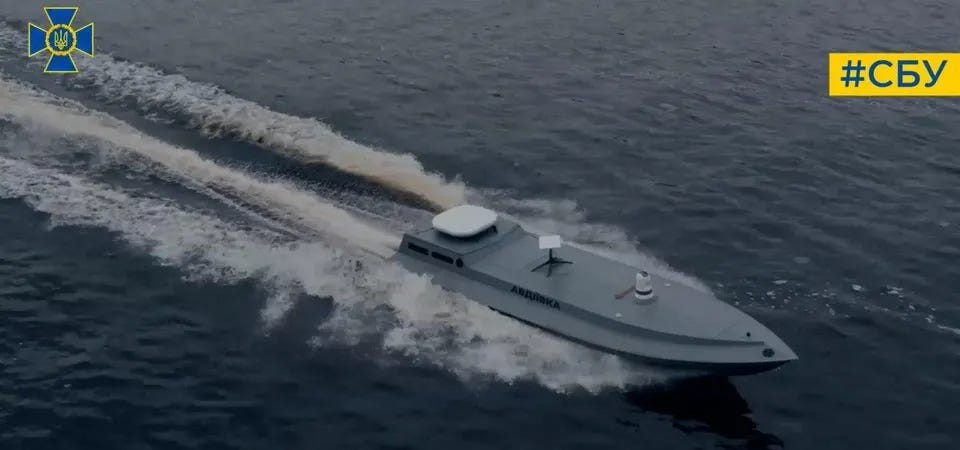
These techniques are not dissimilar to those of Iran’s Islamic Revolutionary Guard Corps. Fast boats with explosives that will harass and outmanoeuvre larger vessels have been normal in the Persian Gulf for years. The difference is that the Black Sea capabilities are unmanned.
More remarkably still, Magura drones shot down two Russian Su-30 fighter jets.10 It was the first time in history that combat aircraft had been destroyed by maritime drones. The implications for air defence, naval protection, and the survivability of high-value platforms are profound.
The technological curve is steepening. Half of all Ukrainian drones procured in 2025 are intended to have some form of AI guidance, up from less than one percent previously. These systems can identify targets and attack without continuous human control. This is no longer science fiction. It is happening on a battlefield three hours’ flight from London.
The electronic warfare contest is equally revealing. Russian forces are highly effective at jamming, to the point where only around 30 percent of Ukrainian drones make it through Russian defences.11 Ukraine has responded by equipping drones with thermal sensors that take control in the final approach. Russia has countered with fibre-optic guided drones, controlled through physical cables running back to the operator. The cables snag like spiders’ webs across fields and on trees and power lines, but they cannot be jammed. They work.
In turn, Ukraine has engineered countermeasures: rotating barbed wire traps to snare the filaments as they drag along the ground, as well as drone interceptors that can knock the un-jammable drones out of the sky. Each breakthrough is quickly met with a response, an echo of the war of attrition seen in mud on the ground.
Perhaps most striking of all is how this ecosystem is managed. Ukraine runs a gamified digital platform where soldiers upload videos of drone strikes and earn points. Six points for an infantryman, forty for a tank, fifty for a rocket battery.12 Those points can be redeemed in an online marketplace for more drones. War has been turned into a feedback loop of data, incentives, and rapid adaptation.
This feedback loop now extends to foreign companies. According to Kateryna Bondar, a former Ukrainian government advisor, some Ukrainian units have begun charging Western defence firms a fee to operate their drones in battle. In return, the companies receive reams of real-world data that cannot be replicated on a test range. Ukraine has become Europe’s living laboratory for the future of warfare.13
Britain’s Strategic Defence Review acknowledges that something fundamental has changed. It commits to creating a Defence Innovation organisation and ringfences 10 percent of equipment spending for emerging technologies. It calls for a digital targeting web linking sensors, shooters, and decision-makers across all domains, crewed and uncrewed. The Army is supposed to become ten times more lethal.
This vision is already being tested. Last spring, 3,000 soldiers of the UK’s 4th Light Brigade, the Black Rats, deployed to Estonia for a NATO’s Exercise Hedgehog. It wasn’t the 69-ton battle tanks, Apache helicopters, or truck-mounted rocket launchers that made a difference, but an invisible automated intelligence network, conceived and assembled in just four months, known as Project ASGARD.
“ASGARD helps double our lethality and exponentially reduces the time to see, decide, and strike. What took hours, now takes minutes,” according to the Chief of the General Staff, the head of the British Army, General Sir Roly Walker.14
What it does is simple: connecting everything that looks for targets with everything that shoots at them through a single, shared electronic brain.
Reconnaissance drones scan the ground so that when a tank is detected, it transmits the image and location directly to whatever can destroy it: an artillery cannon, another tank, or an armed loitering munition drone. The soldiers responsible for each weapon interface with the targeting web through Samsung smartphones selecting targeting options based on the probability of kill.

British officials claim the targeting web’s kill-chain, from first detection to strike decision, could take less than a minute. It is slated to be completed by 2027. Germany plans to deploy its own targeting web, Uranus KI, as early as 2026.15
On paper, this sounds like recognition of reality. In practice, the picture is muddier.
The Ministry of Defence has begun to move. The government has spent around £2 billion on 30,000 first-person view drones, £1 billion on new air defence systems, and £316 million to accelerate the DragonFire directed energy weapon programme by five years.16 These are not trivial sums. But they sit alongside the reality that much recent defence spending has been absorbed by inflation, accommodation costs, and nuclear modernisation.
The Defence Investment Plan, intended to set out spending priorities for the next decade, was due last autumn. It has still not appeared.
The review itself admits that previous attempts to create integrated digital networks have failed. That should raise alarm bells. General Walker already had a target to double Army combat power by 2027 and double it again by 2030.17 How that ambition maps onto a claim of being ten times more lethal has not been explained. The Defence Uncrewed Systems Centre is meant to be operational by February 2026. That is weeks away. It remains unclear whether it will be an engine of rapid delivery or simply another committee with a modern name.
Meanwhile, the British Army currently fields just 14 modern self-propelled artillery guns.18 Fourteen. In a war where massed fires once dominated and are now being overtaken by drones, Britain risks having neither.
The scale of the challenge is staggering. EU Defence and Space Commissioner Andrius Kubilius has estimated that in the event of a wider war with Russia, the EU would need three million drones annually just to hold Lithuania, a country of 2.9 million people, less than 1/3 of one percent of NATO’s population.19
European defence firms are scaling up, but the gap remains vast. The German startup Helsing says its first factory in southern Germany can produce 1,000 drones a month, roughly six per hour. At that pace, it would take a year to fill Germany’s current order. But Helsing now argues that Germany alone should maintain a stockpile of 200,000 of its HX-2 strike drones to tide it over for the first two months of a Russian invasion.20
The deepest obstacle is not technology. It is culture.
British defence procurement is built around long-term programmes, fixed requirements, and established suppliers. That model provides stability, but it resists speed and change. It struggles in an environment where old systems, even the latest drones, are obsolete in days, not decades. That’s a massive change: defence procurement has to shift from periodic acquisition to continuous acquisition.
Ukraine has shown what happens when necessity forces change. New drone variants are designed, built, tested, and deployed in weeks. Failed designs are discarded without sentiment. Success is measured in effect, not pedigree.
But not all claims of progress should be taken at face value. Bohdan Sas, founder of the Ukrainian drone company Buntar Aerospace, told MIT Technology Review that he finds it amusing when Western companies claim to have achieved “super-fancy recognition and target acquisition” in testing, only to reveal that the test site was an open field and a target in the centre.
“It is not really how it works in reality,” Sas says. “In reality, everything is really well hidden.” Russian forces have reportedly deactivated the autonomous functionalities of their Lancet loitering munitions when AI fails in real-world conditions.21
Contrast the UK with Silicon Valley firm Anduril. Its founder, Palmer Luckey, described building an autonomous underwater vehicle capable of travelling a thousand miles without surfacing in a matter of days.22 Traditional naval procurement would take years. The Pentagon has responded with its Replicator initiative, aimed at mass-producing drones for a potential conflict over Taiwan. Admiral Samuel Paparo, Commander of US Indo-Pacific Command, has said he intends to “turn the Taiwan Strait into an unmanned hellscape”.23
Even in the United States, officials acknowledge the scale of the challenge. Former National Security Adviser under President Joe Biden, Jake Sullivan, has described rebuilding the defence industrial base as “a generational task”.24 Britain’s industrial base is smaller, older, and under even greater strain.
What can be done
Preparing demands more than we have done so far and that means rethinking how we buy, not just what we buy.
First, the Defence Uncrewed Systems Centre must be empowered to deliver at speed. If it becomes another layer of governance rather than a fast track to the frontline, it will fail. Its measure of success should be how quickly new systems reach combat units, not how neatly processes are followed.
Second, Britain must learn directly from Ukraine. That means drawing the lessons embedded British officers can learn from Ukrainian drone units and bringing Ukrainian engineers into British programmes. Ukraine has accumulated more practical knowledge about modern warfare in three years than most NATO armies have in three decades. That experience is priceless.

Third, we must confront the implications for legacy platforms. If a £100 million system can be destroyed by a £1,000 drone, the economics of war have changed. That does not mean abandoning sophisticated capabilities, but it does mean rethinking their strategic value and how that value is protected. At some point, we need to accept that the world has changed, and if these ratios do not change, we will be destroyed without any ability to respond.
Instead of building exquisite weaponry costing hundreds of millions, modern war, including the counter insurgencies we fought in Iraq and Afghanistan, favours low-cost, high-volume systems that are effectively disposable. The question is whether Britain’s procurement culture, industrial base, and political leadership can adapt fast enough. The reason for writing articles like this one is to ensure that we have a public debate on the threats we face and the reality of the challenge of retooling our defence.
Ukraine is showing what adaptation looks like when survival is at stake. Britain may not have the luxury of learning slowly.
Army Technology, Drones now account for 80% of casualties in Ukraine-Russia war, April 2025. https://www.army-technology.com/news/drones-now-account-for-80-of-casualties-in-ukraine-russia-war/.
The New Yorker, Is the U.S. Ready for the Next War, July 2025. https://www.newyorker.com/magazine/2025/07/21/is-the-us-ready-for-the-next-war.
The New Yorker, The Future of Warfare Comes to America, July 2025. https://www.newyorker.com/newsletter/the-daily/the-future-of-warfare-comes-to-america.
Arthur Holland Michel, The future of autonomous warfare is unfolding in Europe, MIT Technology Review, January 2026. https://www.technologyreview.com/2026/01/06/1129737/autonomous-warfare-europe-drones-defense-automated-kill-chains/.
President of Ukraine, Today, More Than 80% of Enemy Targets Are Destroyed by Drones, with the Overwhelming Majority Being Domestically Produced, January 2026: https://www.president.gov.ua/en/news/prezident-na-sogodni-ponad-80-vorozhih-cilej-znishuyutsya-sa-102585.
UN News, Russian army committing murder in Ukraine: Independent rights commission, January 2026: https://news.un.org/en/story/2025/10/1166189.
Austrian Federal Ministry for European and International Affairs, Killer robots on the battlefield, April 2024. https://www.bmeia.gv.at/en/ministerium/presse/aktuelles/2024/04/killer-robots-on-the-battlefield.
Ministry of Defence of Ukraine, The ‘Drone Line’ project has been launched in the Defence Forces of Ukraine to develop UAV-operating units, March 2025: https://mod.gov.ua/en/news/the-drone-line-project-has-been-launched-in-the-defence-forces-of-ukraine-to-develop-uav-operating-units.
Newsweek, Crimea Warship Sunk by Drone ‘Wolfpack’, February 2024: https://www.newsweek.com/crimea-warship-sunk-drone-wolfpack-black-sea-1869910.
CNN, Ukraine claims it destroyed Russian fighter jet using seaborne drone for the first time, May 2025. https://edition.cnn.com/2025/05/04/europe/ukraine-destroyed-russian-jet-seaborne-drone-first-intl.
Observer Research Foundation, Ukraine’s Drone War: From Improvisation to Systematised Combat, January 2026. https://www.orfonline.org/expert-speak/ukraine-s-drone-war-from-improvisation-to-systematised-combat.
Time, How Ukraine Gamified Drone Warfare, September 2025. https://time.com/7319847/7319847/.
CSIS, How and Why Ukraine’s Military Is Going Digital, October 2025: https://www.csis.org/analysis/how-and-why-ukraines-military-going-digital.
UK Government, Fundamental lethality shift for British Army spearheaded by novel targeting tech ‘ASGARD’, July 2025: https://www.gov.uk/government/news/fundamental-lethality-shift-for-british-army-spearheaded-by-novel-targeting-tech-asgard#:~:text=Using%20a%20novel%20acquisition%20approach,partners%20to%20improve%20core%20capability.
DSEI Gateway News, Germany approves procurement projects, plans AI reconnaissance system, December 2025: https://www.dsei.co.uk/news/germany-approves-procurement-projects-plans-ai-reconnaissance-system.
The Times, UK invests £20m in laser weapons to protect against drone attacks, January 2026. https://www.thetimes.com/uk/defence/article/dragonfire-iron-beam-laser-weapons-uk-britain-vqd9klvwd.
UK Ministry of Defence, Chief of the General Staff Speech at RUSI Land Warfare Conference 2025, June 2025. https://www.gov.uk/government/speeches/chief-of-the-general-staff-speech-at-rusi-land-warfare-conference-2025.
Defence Express, UK Left With 14 Archers: Defence Giants Now Pitching Buggy-Howitzer Combo as Artillery Solution, November 2025. https://en.defence-ua.com/news/uk_left_with_14_archers_defense_giants_now_pitching_buggy_howitzer_combo_as_artillery_solution-16506.html.
Chatham House, Andrius Kubilius: NATO states need millions of drones for the day Russia might attack, June 2025: https://www.chathamhouse.org/publications/the-world-today/2025-06/andrius-kubilius-nato-states-need-millions-drones-day-russia.
Helsing, Helsing to produce 6,000 additional strike drones for Ukraine, February 2025: https://helsing.ai/newsroom/helsing-to-produce-6000-additional-strike-drones-for-ukraine.
Arthur Holland Michel, The future of autonomous warfare is unfolding in Europe, MIT Technology Review, January 2026. https://www.technologyreview.com/2026/01/06/1129737/autonomous-warfare-europe-drones-defense-automated-kill-chains/.
CBS News, Tech billionaire Palmer Luckey wants to remake the U.S. military with autonomous weapons, May 2025. https://www.cbsnews.com/news/palmer-luckey-future-warfare-anduril-60-minutes/.
U.S. Naval Institute, Envisioning a Hellscape: Ukrainian Lessons for a Taiwan Drone Strategy, April 2025. https://www.usni.org/magazines/proceedings/2025/april/envisioning-hellscape-ukrainian-lessons-taiwan-drone-strategy.
The American Presidency Project, Remarks by National Security Advisor Jake Sullivan on Fortifying the U.S. Defense Industrial Base, December 2024. https://www.presidency.ucsb.edu/documents/remarks-national-security-advisor-jake-sullivan-fortifying-the-us-defense-industrial-base.

Really interesting article. The Ukraine war is clearly highlighting how cost asymmetry favours cheap, adaptable drones over high-value platforms.
Do you think this dynamic could be even more consequential in the maritime theatre, especially for Britain as a trading island nation reliant on secure sea lanes and a small number of critical naval assets?